
Understanding Functional Capacity Evaluations (FCEs) and Their Role in Return-to-Work Decisions

Understanding Functional Capacity Evaluations (FCEs)
and Their Role in Return-to-Work Decisions
When someone is injured, recovering physically is only part of the story. The more complicated (and often more consequential) question is: Can they return to work safely and effectively? This is where Functional Capacity Evaluations (FCEs) become a critical tool. In this post, we explain what FCEs are, how they work, their strengths and limitations, and why they matter for return-to-work decisions, workers’ compensation, and workplace safety.
What Is an FCE — Definition, Purpose, and Who Performs It
A Functional Capacity Evaluation (FCE) is a structured, systematic assessment designed to measure an individual’s physical (and sometimes functional) capacity relative to the demands of a job. Rather than simply considering an injury or diagnosis in abstract, an FCE attempts to answer: What can this person actually do in real-world, work-related tasks?
FCEs are typically ordered when someone has suffered a work-related injury or illness and is ready to enter the next phase: evaluating whether they can safely return to work, and if so, under what restrictions or accommodations. They are also used in disability or workers’ compensation contexts to objectively assess a person’s work capacity.
Importantly, these evaluations are usually conducted by licensed clinicians, most commonly physical therapists or occupational therapists, who are trained to assess neuromusculoskeletal conditions, pathology, and the functional implications of injuries. This ensures that the evaluation is comprehensive, clinically informed, and impartial.
What Happens During an FCE: Components & Process
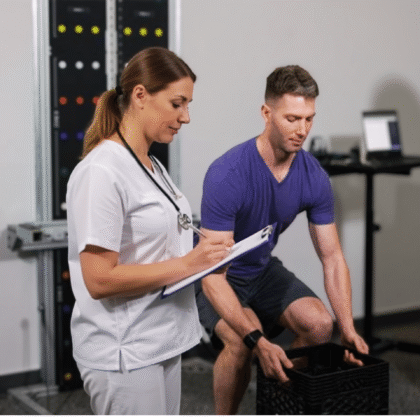
An FCE is not a quick checklist; it is a tailored, in-depth assessment. Although each FCE is customized to the individual’s injury and job demands, certain core elements are common:
- Medical and occupational history review (including the nature of the injury, treatments received, job description, prior physical demands)
- Functional testing (a battery of standardized tests that may include lifting, carrying, pushing/pulling, walking, stair climbing, balance, sitting/standing tolerance, range of motion, grip strength, and other job-relevant motions)
- Observation and effort evaluation (the evaluator monitors for signs of consistency of effort, pain behavior, and any limitations in performance. This helps guard against exaggerated or sub-maximal effort, and adds credibility to the assessment)
- Report and recommendations (after testing, the evaluator compiles a detailed report summarizing findings, functional capacities, limitations, and recommendations: whether the individual can return to full duty, require modified duty, or need restrictions/accommodations such as lifting limits, sedentary work only, modified hours)
According to one prominent guideline, Current Concepts in Functional Capacity Evaluation: A Best Practices Guideline, the goal of an FCE is “to provide a foundation for objective, reproducible, and clinically valid assessment” of functional capacity in relation to real work demands.
Why FCEs Matter: Benefits and Practical Use Cases
Objective, Task-Based Assessment (Beyond Diagnosis)
Medical diagnosis alone, even when combined with physician opinion, may not fully capture a worker’s ability to perform job tasks. An FCE adds a functional, performance-based dimension. It measures what the individual can do rather than what their diagnosis or imaging suggests.
Informed Return-to-Work and Accommodation Decisions
For employers, insurers, case managers, and treating physicians, FCEs offer concrete data to guide return-to-work decisions. This may include whether to allow full duty, require modified or light duty, or recommend workplace accommodations. It helps align job demands with a worker’s current capabilities, reducing risk of re-injury and promoting safer, more sustainable return-to-work outcomes.
Support for Disability and Compensation Processes
In workers’ compensation or disability cases, FCEs can influence benefit determinations, impairment ratings, and job restrictions. Because the evaluation is standardized, objective, and medically supervised, it carries weight in legal and administrative settings when assessing work capacity or impairment.
Rehabilitation Planning and Vocational Guidance
Beyond return-to-work decisions, FCE results can guide rehabilitation plans, suggest further therapy needs, or help with decisions on vocational rehabilitation or job re-assignment when full-duty return isn’t feasible.
How FCEs Complement (Not Replace) Medical Exams / Impairment Ratings
It is important to recognize that FCEs are not a substitute for a medical exam or an impairment rating; they are complementary. Whereas a medical exam or impairment rating may define the nature and extent of injury (diagnosis, anatomical impairment, pain, pathology), an FCE assesses functional capacity—what the individual can or cannot do, physically, under work-related conditions.
In many workers’ compensation and disability management workflows, both are used: the medical diagnosis/impairment provides the clinical picture; the FCE provides the functional picture. The combination offers a more comprehensive, balanced, and defensible basis for return-to-work decisions, accommodations, or disability determinations.
Limitations, Challenges, and What FCEs Cannot Provide
As powerful as FCEs are, they have inherent limitations that must be recognized, especially when presenting an objective, balanced view.
-
- Effort, pain, and motivation affect validity: Because performance depends in part on effort, pain tolerance, and perceived pain, results may not always reflect a person’s “true” capacity, especially if they hold back due to fear, pain, or desire to avoid re-injury.
- Snapshot in time, not a guarantee of long-term outcome: An FCE shows whether someone can perform certain tasks on the day of the test. It does not guarantee that the person will sustain those abilities over weeks, months, or under real-world job stressors.
- May not capture non-physical limitations: Many jobs involve cognitive, psychological, environmental, or ergonomic demands (stress, mental workload, dynamic conditions, fatigue over time, variability). FCEs focused on physical tasks may overlook these non-physical but essential factors.
- Need for standardized protocols and qualified evaluators: To be defensible and reliable, FCEs must be conducted per recognized guidelines (e.g., “Current Concepts …”) and by qualified clinicians (typically physical or occupational therapists). Deviations can undermine validity.
In short, FCEs are a valuable piece of the puzzle, but should be viewed as one component of a comprehensive, multidisciplinary assessment.
Practical Implications: For Employers, Insurers, Clinicians, and Workers
As powerful as FCEs are, they have inherent limitations that must be recognized, especially when presenting an objective, balanced view.
-
- Employers & Insurers: Use FCEs to ensure safe return-to-work, match worker capacity to tasks, reduce risk of re-injury, and support defensible decisions for accommodations or modified duty.
- Clinicians & Therapists: Incorporate FCEs as part of rehabilitation planning and discharge criteria; use the data to guide therapeutic goals, job-matching, and functional recovery.
- Workers / Claimants: Understand that FCEs are about function, not just diagnosis. Be prepared to participate fully and consistently (effort, honesty, communication). The results may affect return-to-work status, job modifications, or ongoing restrictions.
- Case Managers & Vocational Counselors: Use FCE results to guide job placement, modified duty planning, and long-term vocational strategies, especially when previous job tasks exceed the worker’s evaluated capacity.
Conclusion
At Comprehensive Diagnostic Center, we understand that a Functional Capacity Evaluation, when properly administered by qualified professionals, offers a critical bridge between the clinical world of diagnosis/impairment and the practical world of work demands and job performance. It turns subjective injury diagnoses into objective, measurable, task-based evaluations.
But it is not a magic bullet. Its value depends heavily on standardized protocols, honest and consistent effort, and thoughtful interpretation. And perhaps most importantly: FCEs should be considered part of a broader decision-making framework, alongside medical exams, job analyses, ergonomic reviews, treatment history, and real-world factors.
For employers, insurers, clinicians, and workers alike, FCEs can, and should, serve as a foundation for safer, fairer, and more informed return-to-work decisions. Call 800-494-0321, click: www.cdcime.com, or email: referrals@cdcime.com TODAY.
References
- Functional Capacity Evaluation (FCE) Guidelines. WorkSafeBC, 2021. https://www.worksafebc.com/en/health-care-providers/rehabilitation/functional-capacity-evaluation
- Canadian Centre for Occupational Health and Safety (CCOHS). Functional Abilities Evaluation / Return-to-Work. https://www.ccohs.ca/oshanswers/psychosocial/rtw/rtw_abilities.html
- “Functional Capacity Evaluation (FCE) Frequently Asked Questions.” Enlyte, 2023. https://www.enlyte.com/insights/article/specialty-physical-medicine/functional-capacity-evaluation-fce-frequently-asked
- Orthopaedic Section of the American Physical Therapy Association. Current Concepts in Functional Capacity Evaluation: A Best Practices Guideline. June 20, 2018. https://www.orthopt.org/uploads/content_files/files/2018%20Current%20Concepts%20in%20OH%20PT-FCE%2006-20-18%20FINAL.pdf
- Jahn, W. T. “Functional and Work Capacity Evaluation Issues.” Journal of Chiropractic Medicine 3, no. 2 (2004): 55–60. https://www.ncbi.nlm.nih.gov/pmc/articles/PMC2646981/